
Private Equity
The Value Creation Plan Doesn’t Create Value. The Executive Team Does.
Private equity has dramatically improved investment performance by bringing greater rigor to investment selection, due diligence, capital allocation, and value creation planning. Once the transaction closes, execution becomes the primary driver of value creation. The value creation plan establishes the direction, but the portfolio company’s CEO and executive leadership team determine whether the investment thesis becomes reality.
Topgrading helps private equity firms objectively evaluate, strengthen, and govern executive teams throughout the investment lifecycle.
Closing the Deal Changes the Question.
Investment committees evaluate management teams alongside financial performance, commercial opportunity, operational capability, and strategic fit during due diligence.
The purpose of that evaluation is to support the investment decision. Given the realities of diligence—limited time, limited access, and competing priorities—the assessment of the management team is necessarily shallower than the analysis applied to the business itself.
After closing, the question changes to,
“How do we maximize the value of that investment.”
Answering that question requires a deeper understanding of the executive team
than due diligence is designed to provide.
The First 100 Days Set the Trajectory
The first months after closing provide complete access to the organization, its leaders, and the broader business context. As firms refine the value creation plan, they have an opportunity to objectively evaluate the executive team and establish a talent roadmap for the hold period.
Early decisions can shape the trajectory of an investment for years. That opportunity remains valuable later in the hold period. Developing a deeper understanding of the executive team can strengthen execution at any stage of the investment lifecycle.
Those insights help operating partners, boards, and CEOs focus development, succession, and talent decisions where they can have the greatest impact on value creation.
Executive Teams Continue to Evolve.
The executive team that begins the hold period rarely looks the same when the investment exits. Businesses evolve, strategies change, acquisitions reshape organizations, and new capabilities become essential.
The strongest firms recognize that executive team development is an ongoing process.
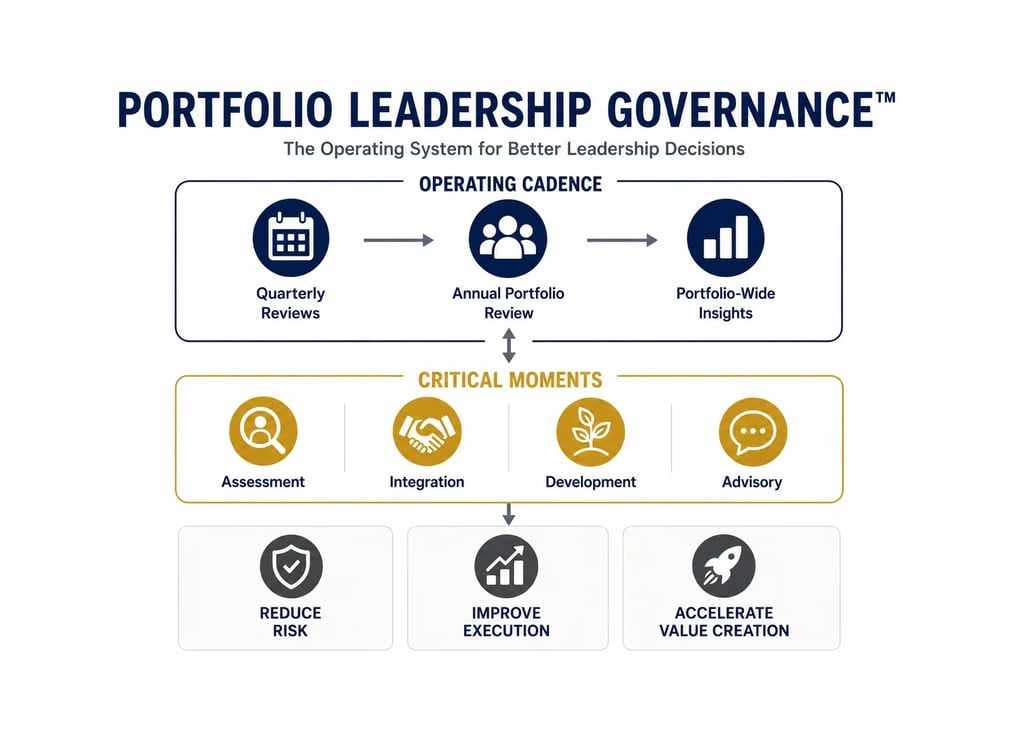
We call that Portfolio Leadership Governance™—a structured approach to continuously evaluating, strengthening, and evolving executive teams throughout the investment lifecycle.
How We Partner with Private Equity Firms
| Investment Lifecycle | Representative Solutions |
|---|---|
| Critical executive hiring | Leadership Investment Analysis |
| Immediately after closing | Executive Team Assessment & Executive Roadmap |
| Throughout the hold period | Quarterly Leadership Reviews |
| CEO and executive transitions | Executive Integration & Acceleration |
| Portfolio oversight | Annual Portfolio Leadership Reviews |
Each engagement builds a deeper understanding of the executive team and supports stronger execution throughout the investment lifecycle.
Better Executive Teams.
Better Execution.
Better Investment Outcomes.
A disciplined investment process identifies attractive opportunities.
A disciplined approach to strengthening executive teams helps maximize enterprise value.
If you’re interested in strengthening one of the most influential drivers of investment performance, we’d welcome the opportunity to start a conversation.